

The need for substantive Indefinite Leave to Remain reform
Since 1997 every single election-winning manifesto has vowed to reduce or control migration, including Labour’s in 2024. More than anything else, the repeated failure to deliver on this promise has damaged the bond between voters and politicians. It was primarily the Conservatives’ open-borders experiment of unprecedented levels of immigration that led to their dethroning in 2024, and their current nadir.
As various writers have noted, immigration policy is hard: ministers must navigate a complex web of trade-offs and competing vested interests. It is much easier for a government to embrace the short-term appeal of a liberalised immigration system than to fork out the cash to invest in local skills. Amidst a wider context in which Labour has struggled to deliver on many of its manifesto ambitions, it is striking that this government is the first in modern British history to end this cycle of failure, recognising the legitimate views of British voters.
This success has not been adequately recognised by the political establishment that seems surprised Labour has delivered where many others could not. The complexity of immigration policy making has given rise to hard decisions for the current home secretary – none more so than the question of how to deal with the imminent settlement of a large wave of low-waged workers who arrived between 2021 and 2024. For Labour to cross the finish line, it must deliver Shabana Mahmood’s solution to that problem, with reforms to Indefinite Leave to Remain (ILR) applying retrospectively. While some of the arguments against are superficially attractive, upon interrogation, or when set in their broader context, they do not stand up. The Labour Party cannot transfer the costs of a Conservative mistake on immigration policy onto the British people and win the next election.
The Home Office intends to double the time it takes most migrant workers to qualify for permanent residence from five years to ten years, including for migrants already in the country. This is because ILR acts as the main gateway to receiving almost all benefits, including universal credit, child benefit, and housing support. An individual who has obtained ILR becomes eligible for social housing and council housing support.
The numbers
Sunder Katwala has frequently noted that the overall fall in migration numbers is the biggest kept secret in British politics. Yet, the implicit point that this somehow undermines the proposed ILR reforms is a misreading of their nature and necessity.
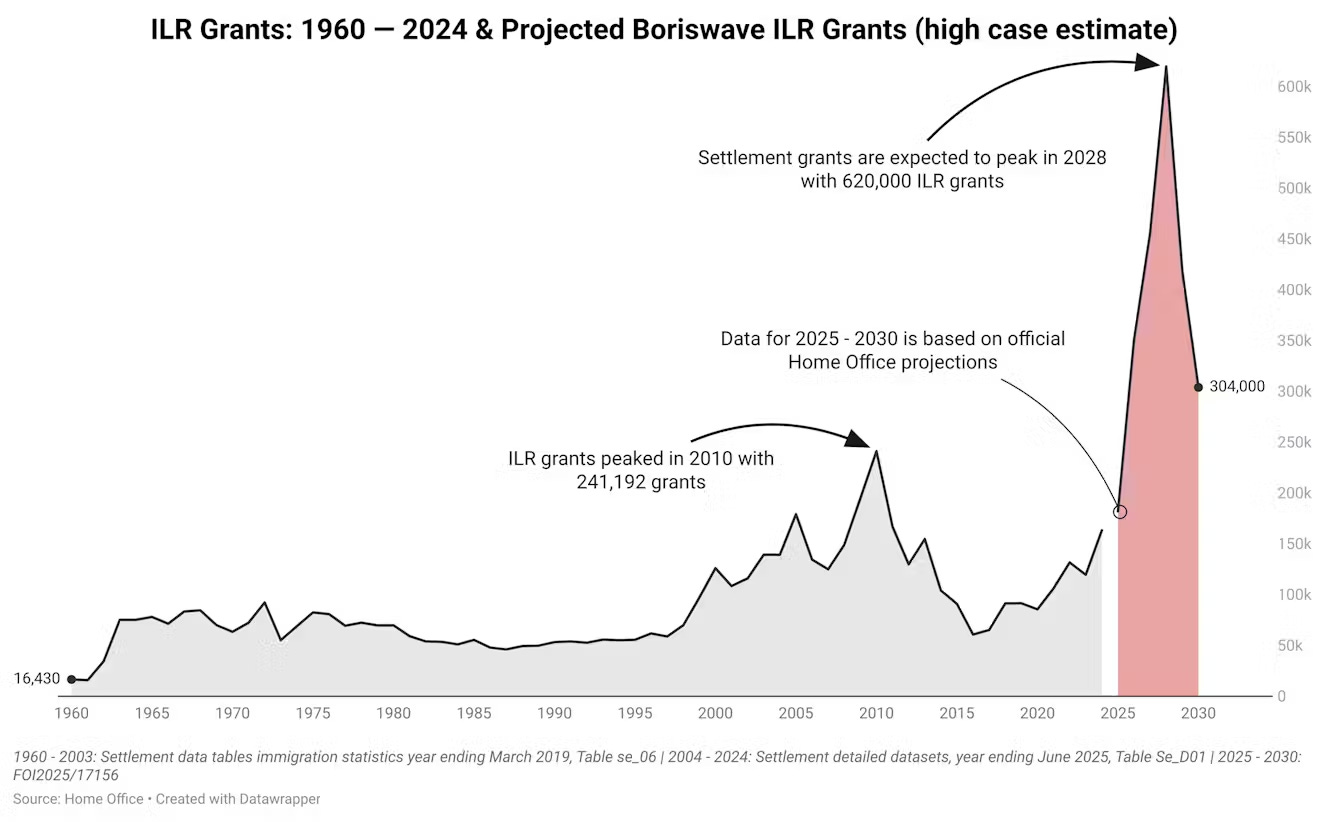
Between 2021 and 2024, more than 3.6 million people arrived in what is known colloquially as the Boriswave. Overwhelmingly low-paid and lower-skilled, once through the ILR gateway these individuals are likely to depend on welfare at both the national and local level, adding a substantial burden onto already stretched public services. As the graph below demonstrates, ILR grants will peak in 2028, just as Labour prepares to fight the next election.
Katwala’s point, that we are on the brink of net-zero or negative migration, has little bearing on the issue at hand, which is about the impact of people already here. And a failure to apply retrospective ILR reforms risks squandering any room for positive action on high-skilled migration once the dust has settled.
In a period of 65 years between 1960 and 2025, the Home Office issued what were effectively 5.8 million grants of ILR. The Home Office’s estimate is that without these reforms there will be between 1.3 and 2.2 million individuals claiming ILR in just 7 years.
The IPPR memo
In late March an IPPR briefing paper opposing the reforms was disseminated among Labour MPs and sent to the Home Office. It sets out four main arguments, which we analyse in turn.
IPPR are correct in their first argument that there is not a direct £10 billion saving to be made by withholding ILR retrospectively. However, this does not advance their argument any further than this, and the Home Office’s original point, that there are considerable financial costs associated with this policy, remains true. The £10 billion figure refers to the long-term net-negative contribution of the 350,000 individuals who arrived through the health and social care worker visa and are likely to apply for ILR. That specific costs are hard to quantify does not, in the absence of other evidence, undermine the Home Office’s motivating point.
Jonathan Portes has set out a more substantive critique of this number, yet as he notes, critical uncertainties remain, and his figure will be an underestimate. Portes’ analysis is undermined by a number of factors, including the unsupported assumption that care workers are equally as likely to apply for ILR as other workers (it is reasonable to assume they are more likely to apply), the exclusion of the impact of child dependents, the assumption that care workers would switch to higher-paid jobs once granted ILR, and a lack of detailed analysis on the average age of the cohort and the relevant cost implications. In the face of those uncertainties, Labour MPs should be minded to adopt the precautionary principle, whilst paying attention to the sharp rise in welfare claims from those with ILR.
Secondly, they argue that delaying the ability to claim ILR will have a fiscal cost because migrants will be kept in lower-paid roles for longer. They argue that were these changes not made, care workers are likely to move into other higher-paid roles once granted settlement. However, they provide no evidence or analysis to show that this is true. Given the low transferrable skills of most of those who arrived in the Boriswave, it is hard to see what professions large numbers might move into, other than gig economy work. Set in a wider context of a weak and struggling labour market for job-seekers, we do not see how low-skilled workers will transition into higher wage roles.
Moreover, even were IPPR’s analysis correct, the Government would face a significant shortfall in care workers, putting us back in the same situation that led to the creation of the disastrous visa in the first place. As Marley Morris, who leads IPPR’s work on migration policy, has argued elsewhere, the Government introduced the social care route for migrants for the sole purpose of addressing a shortage of care workers. They now appear to advocate for a policy that would recreate that shortage.
The academic literature on this specific question is understandably limited, but a previous study of a similar visa in Canada undermines IPPR’s argument on both counts. While most care workers switched out of the care industry (just 15% remained in the sector), they often remained in low-paid work. Should a similar scenario play out here, the Government would face a double-edged sword of low-fiscal contribution and a new social care worker shortage.
This takes us to IPPR’s third point where they suggest that savings would take decades to materialise (built on the unproven assumption care workers and adult dependents would continue to be net fiscal contributors). There are basic reasons to dispute this, not least because the median age of the cohort matches the UK average, and their economically productive working years are therefore limited.
But even if we accept their case, it is a strikingly short-term assessment, particularly where the briefing notes that “given the fiscal rules work to a 5-year horizon, the emigration of care workers would make it harder - not easier - for the Treasury to meet its fiscal targets”. Portes makes a similar mistake, suggesting that “the relevant question is the impact over the forecast horizon” and that “these cohorts improve the public finances over the period [up to 2029-2030] that is relevant for fiscal policy”.This is the tried, tested, and failed approach taken to decades of migration policy. Britain cannot continue to determine its migration approach on the basis of a five-year horizon. As Madeline Sumption, the director of the Migration Observatory, has noted, “many of the costs of migration come decades down the line, while benefits come sooner”.
IPPR’s final claim that this policy could deter high-paid skilled workers is fundamentally unsupported. The explicit purpose of these reforms is to transition towards a contributory model in which high earners are rewarded with easier routes to settlement. Alan Manning has argued, supported by a good deal of academic literature, destination choice is a high salience issue for immigrants. If the Home Office manages to thread the needle, it stands to reason that the barriers to entry for genuinely high-skilled immigrants will decrease, rather than increase.
“Un-British”?
Some 30 years ago, Roy Hattersley suggested that the question that dominated Labour in relation to a policy was ‘is it really socialist?’, a question that he noted could not be answered in any sensible way without an agreed definition of what socialism is. That question is rarely asked today. Rather, “Labour” or “British” values are regularly invoked, but the same problem Hattersley identified still applies. That is how one notable opponent of these reforms can describe them as un-British, whilst having suggested the Government strip migrant access to the welfare system to address exactly the same problem.
Hattersley noted that, rather than applying an indistinct value test, one should turn to R.H. Tawney’s instructive advice where he stated that: “whether in any particular instance it is desirable or not is a question to be decided in the light, not of resounding affirmations of the virtues of either free enterprise or of socialisation, but on the facts of the case”. Emily Thornberry and Tony Vaughan have put forward superficially persuasive arguments about the problems with these reforms. These are superficial because they fail to situate themselves in the broader context amidst what Luke Tryl describes as the “thermostatic turn against welfare spending and tax”, as social attitudes begin to shift. George Robertson has noted correctly that “we cannot defend Britain with an ever-expanding welfare budget” which should be read as a direct rejoinder to those like Emily Thornberry who simultaneously argue for an expansive vision of ILR, and that Britain has “chronic underfunding of our navy”. One cannot, in any good faith, turn on a tap in full knowledge that it is impossible to turn off down the line.
If, ultimately, this is a question of fairness, MPs must look to the wider picture. Would it be fair to saddle the costs of failed Conservative policy onto the British taxpayer? Any asymmetric approach to fairness will alienate the voters key to retaining some semblance of Labour’s 2024 success. Unable to curb non-discretionary spending, Labour would be forced to inflict further cuts on the public realm and therein the social contract, causing profound damage to its attempts to improve the lives of the average person through investments in their local community. Less police on dilapidated high streets, more potholes. Britain in visible decline.
It is in this context that, even if it were otherwise desirable, the Labour government cannot in good conscience offer ILR to those who arrived through the ‘seriously flawed’ Social Care visa. It was not the Labour Party that made a catastrophic error in its creation in hock to employer lobby groups. It would therefore be an act of self-inflicted political harm for the Labour government to assume responsibility for this error, particularly when the current Home Secretary is offering a route out. Regardless of the results of the local elections next week, with three years before the next election, there is plenty of time for the government to reverse current narratives. But any such effort, whether it is conducted by Keir Starmer, or his successor, risks floundering if those years are dominated by the unfolding financial consequences of failure to make the right decision on ILR. Labour MPs must therefore rally behind Shabana Mahmood and her reforms.
Good piece, thanks. But I think you meant to refer to the excellent George Robertson, not the less excellent Geoffrey Robertson …
Retrospective changes are never just. We recruited people from Africa and other countries. Although it's a conservative mistake we promised these people that after 5 years they can apply. There was a cost to them on leaving their home country and coming to help us. Fairness should rule. It's such a shame that Labour has come to this